SPC-ELL: Nouns and Articles
Self-Paced Collection of English Language Lessons
Make sure you "allow" blocked content and turn your speakers on to use this SoftChalk lesson. Watch the videos, listen to the recordings, and read the explanations on each page. Put your mouse over the bold words to read and see more. You can visit each page and try each activity as often as you want for practice.
When you want your answers to count, complete all activities and questions in order on each page, click "Check Answers" and then next page to continue.
Important - if you want to submit your scores, click Print Score Summary and/or Email Score on the last page according to your teacher's instructions. If you see a Finish button on the last page, click on it to submit your scores directly to your teacher (not all students will see the "Finish" button).
 At the end of this lesson, you should be able to:
Click the play arrow above to listen.
Read the following paragraph. Do you notice any problems?
Story of Coca-Cola
Popular beverage that is sold all over world is Coca-Cola. Doctor who lived in Atlanta, Georgia, invented it in 1886. Dr. John Pemberton, who was pharmacist, first sold Coca-Cola as nerve tonic, stimulant, and headache medicine. Name of dark brown syrup that made people feel better was "Pemberton's French Wine Coca." Later someone added soda water to syrup and it became beverage that is our modern Coca-Cola. First part of name (coca) comes from cocaine, which was one of original ingredients. Second part of name (cola) comes from kola nut, which is still ingredient. Original formula has changed over years. Of course Coca-Cola no longer contains cocaine, which is illegal drug, but it still tastes delicious. Formula for Coca-Cola is secret that is carefully guarded.
Adapted from First Steps in Academic Writing, Level 2 by Anne Hogue, 2008.
What is wrong with this paragraph? Try the "Self Check" question below.

Click the play arrow above to listen and then click on the next page.
In order to talk about article rules in English, we first need to know about nouns.
Click the play arrow above to listen.
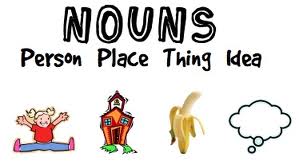
Nouns are words for people, places, things, or ideas. This lesson will focus on 3 kinds of nouns:
|
Singular |
Plural |
Non-Count |
|---|---|---|
|
boy, dog, man, school, neighborhood, mouse, box, baby, tooth |
boys, dogs, men, schools, neighborhoods, mice, boxes, babies, teeth |
water, coffee, sugar, furniture, jewelry, junk, news, tennis, rice, hair, homework, intelligence, information, grammar, swimming, pollution |
Click the play arrow above to listen as you scroll down and read.
1. Regular Nouns
The plural of most regular nouns is formed by adding -s:
|
Singular |
Plural |
|---|---|
|
song |
songs |
|
book |
books |
|
school |
schools |
|
girl |
girls |
|
computer |
computers |
The plural of nouns that end in a consonant + y is formed by deleting -y and adding -ies:
|
Singular |
Plural |
|---|---|
|
baby |
babies |
|
party |
parties |
|
salary |
salaries |
The plural of nouns that end in -sh, -ch, -s, -z, and -x is formed by adding -es:
|
Singular |
Plural |
|---|---|
|
box |
boxes |
|
class |
classes |
|
wish |
wishes |
|
glass |
glasses |
|
watch |
watches |
2. Irregular Nouns
Some nouns have irregular plural forms. (You will need to consult a grammar book for all the rules.)
Here are a few examples:
|
Singular |
Plural |
|---|---|
|
man |
men |
|
child |
children |
|
foot |
feet |
|
tooth |
teeth |
Click the play arrow above to listen.
Non-count nouns have no plural form. For example:
NO: Yesterday, I bought a ring, a necklace, and some earrings. My new jewelries are beautiful.
YES: Yesterday, I bought a ring, a necklace, and some earrings. My new pieces of jewelry are beautiful.
NO: My teacher gave us three homeworks last week.
YES: My teacher gave us three homework assignments last week.
Watch this short video to learn more about count and non-count nouns before you click on the next page.
Try this Sorting Activity to practice.
Click the play arrow above to listen.
Nouns are often the subject of a sentence; however, they can also function as a direct or indirect object.
Example sentences:

Click the play arrow above to listen.
Look at the following sentences. Two of the sentences below are incorrect. Can you tell which two are wrong?
Try the Quiz Group activity below to see which TWO sentences use articles incorrectly. (This quiz is for practice only. Your answers will not count in your grade. All other quizzes & activities DO count.)
Watch this video for a longer explanation of article rules.
Go to the next page and do the practice.
Click the play arrow above to listen.
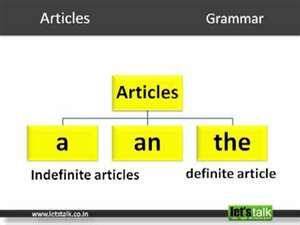
Which article should you choose: the, a, an, Ø?
|
the = definite article (use with singular or plural nouns, sometimes with non-count nouns) |
a, an = indefinite articles (ONLY use with singular nouns) |
Ø = "zero" article (use with non-count or plural nouns) |
|---|---|---|
|
1. use when referring to something specific (singular or plural)
2. use with singular count nouns the second time you mention it |
3. use with a singular count noun to make general statements
4. use with a singular count noun the first time you mention it |
5. use with non-count nouns to make general statements, unless you want to be very specific
6. use with plural count nouns to make general statements |
Read the 6 rules in the table above and then try the 3 activities below.

The Quiz Group below is the same as the Quiz on page 8. Try this quiz again. This time, your answers will count.
Read this paragraph again and decide which articles are missing. Fill in the blanks with the, a, an, Ø. Refer to the table to help you choose the best article.
Click on the Quiz Group below to enter your answers.
1.___ Story of Coca-Cola
2.___ popular beverage that is sold all over 3.___ world is Coca-Cola. 4.___ doctor who lived in Atlanta, Georgia, invented it in 1886. Dr. John Pemberton, who was 5.___ pharmacist, first sold Coca-Cola as 6.___ nerve tonic, stimulant, and headache medicine. 7.___ name of 8.___ dark brown syrup that made people feel better was "Pemberton's French Wine Coca." Later someone added soda water to 9.___ syrup and it became 10.___ beverage that is our modern Coca-Cola. 11.___ first part of 12.___ name (coca) comes from cocaine, which was one of 13.___ original ingredients. 14.___ second part of 15.___ name (cola) comes from kola nut, which is still 16.___ ingredient. 17.___ original formula has changed over 18.___ years. Of course Coca-Cola no longer contains cocaine, which is 19.___ illegal drug, but it still tastes delicious. 20.___ formula for Coca-Cola is 21.___ secret that is carefully guarded.
Adapted from First Steps in Academic Writing, Level 2 by Anne Hogue, 2008.
|
the = definite article (use with singular or plural nouns, sometimes with non-count nouns) |
a, an = indefinite articles (ONLY use with singular nouns) |
Ø = "zero" article (use with non-count or plural nouns) |
|---|---|---|
|
1. use when referring to something specific (singular or plural)
2. use with singular count nouns the second time you mention it |
3. use with a singular count noun to make general statements
4. use with a singular count noun the first time you mention it |
5. use with non-count nouns to make general statements, unless you want to be very specific
6. use with plural count nouns to make general statements |
Congratulations! You are now an expert on nouns and articles in English!
Important - if you want to submit your scores, click Print Score Summary and/or Email Score on the last page according to your teacher's instructions. If you see a Finish button on the last page, click on it to submit your scores directly to your teacher (not all students will see the "Finish" button).
Folse, K., (2009). Keys to Teaching Grammar to English Language Learners: A Practical Handbook. Ann Arbor: University of Michigan Press.
Azar, B. & Hagen, S., (2009). Understanding and Using English Grammar (4th Edition). White Plains, NY: Pearson Longman.